 Japan Guide
If you want to live, work, study, or stay long-term in Japan, you need the right visa. Japan has many visa types, and the names can feel confusing at first.
This guide explains the main types of Japan visas in very simple words, so you can quickly understand which visa fits your situation.
What Is a Japan Visa?
A Japan visa is permission to enter and stay in Japan for a specific purpose.
That purpose could be:
- Tourism
- Studying
- Working
- Living with family
Your visa decides:
- What you can do in Japan
- How long you can stay
- Whether you can work or not
1. Tourist Visa (Temporary Visitor Visa)
Who is this for?
- Short-term visitors
- Tourists
- Family or friends visits
What you can do
- Travel around Japan
- Visit friends or family
- Attend short meetings or events
What you cannot do
- Work
- Get paid
- Study long-term
Duration
- Usually 15, 30, or 90 days
✅ Best for: Travel and short visits
❌ Not for working or living
2. Student Visa
Who is this for?
- Language school students
- University or college students
- Vocational school students
What you can do
- Study in Japan
- Work part-time up to 28 hours per week (with permission)
Duration
- 6 months to 4 years (depends on school)
✅ Best for: Learning Japanese or studying
⚠️ Full-time work is not allowed
3. Work Visa (Most Common for Foreigners)
Japan does not have just one “work visa.”
There are different work visas for different jobs.
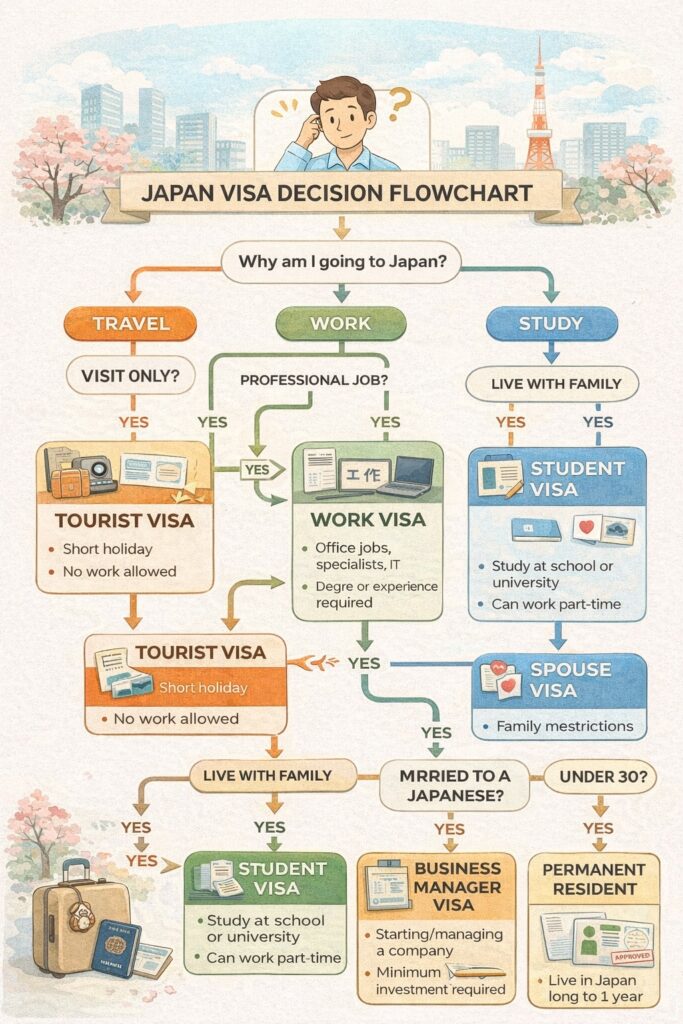
Engineer / Specialist in Humanities / International Services
This is the most common work visa.
Jobs included
- IT and engineering
- Web design
- Marketing
- Translation
- Office jobs
Requirements
- University degree
- Job related to your education or experience
Duration
- 1, 3, or 5 years
✅ Best for: Office workers, IT, professionals
Instructor Visa
Who is this for?
- English teachers
- Teachers at schools (not language schools)
Duration
- 1 to 5 years
Skilled Labor Visa
Who is this for?
- Chefs
- Construction workers
- Craftspeople
Requirements
- Strong work experience
- Skills Japan needs
4. Specified Skilled Worker Visa (SSW)
Who is this for?
- Workers in labor-shortage industries
Fields include
- Nursing care
- Food service
- Agriculture
- Factory work
Levels
- SSW Type 1: Limited stay, no family
- SSW Type 2: Longer stay, family allowed (few fields)
✅ Best for: Blue-collar jobs
⚠️ Rules are strict

5. Dependent Visa
Who is this for?
- Spouse or children of:
- Work visa holders
- Student visa holders
What you can do
- Live in Japan
- Work part-time up to 28 hours per week
Duration
- Same as sponsor’s visa
6. Spouse Visa (Spouse of Japanese National)
Who is this for?
- Married to a Japanese citizen
Big advantage
- No work restrictions
- You can work any job or change jobs freely
Duration
- 1, 3, or 5 years
✅ One of the most flexible visas
7. Permanent Resident Visa
Who is this for?
- Long-term residents who meet requirements
Benefits
- No visa renewal
- No work restrictions
- More stability
Requirements (general)
- Lived in Japan for many years
- Stable income
- Good behavior
8. Working Holiday Visa
Who is this for?
- Young people (usually 18–30)
- From specific countries
What you can do
- Travel
- Work short-term jobs
Duration
- Usually 1 year
⚠️ Only available to certain nationalities
Quick Comparison Table
| Visa Type | Can Work? | Long-term? | Main Purpose |
|---|---|---|---|
| Tourist | ❌ No | ❌ No | Travel |
| Student | ⚠️ Part-time | ✅ Yes | Study |
| Work Visa | ✅ Yes | ✅ Yes | Professional work |
| SSW | ✅ Yes | ⚠️ Limited | Labor jobs |
| Dependent | ⚠️ Part-time | ✅ Yes | Family |
| Spouse | ✅ Yes | ✅ Yes | Family |
| Permanent | ✅ Yes | ✅ Yes | Settle |
Common Visa Mistakes to Avoid
- Applying for jobs without the right visa
- Assuming tourist visa allows work
- Choosing the wrong work visa type
- Not checking renewal deadlines
Final Thoughts
Japan visas may seem complicated, but once you understand your purpose, the right visa becomes clear.
Ask yourself:
- Am I coming to study, work, or live with family?
- Do I need work permission?
- How long do I want to stay?
Start with the correct visa, and your life in Japan will be much smoother.